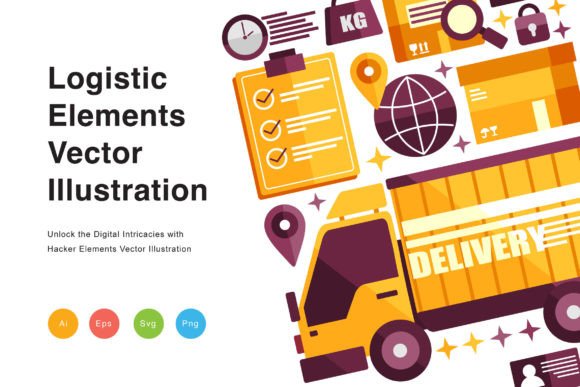
Visualizing Supply Chains: The Power of Logistic Elements Vector Illustration
Beyond Clip Art: Why Vector Illustrations Define Modern Logistics Communication
In an industry built on precision, timing, and interconnectivity, the way we visually communicate logistics concepts matters. A poorly chosen generic icon can confuse an audience, while a meticulously crafted visual can clarify a complex workflow in seconds. This is where the Logistic Elements Vector Illustration set steps in as more than just decoration—it becomes a functional tool. Vectors offer inherent advantages over raster images: they scale infinitely without losing resolution, they remain crisp on everything from a smartphone screen to a billboard-sized infographic, and they allow for easy color adjustments to match brand guidelines. In logistics, where diagrams, route maps, and cargo layouts are frequent necessities, having a consistent vector library ensures that every visual asset communicates the same level of professionalism and clarity that the industry itself demands.
For Educators and Trainers
When teaching supply chain fundamentals—whether in a corporate training room or a university lecture hall—visual aids can transform abstract concepts into tangible understanding. A Logistic Elements Vector Illustration of a container ship, a warehouse rack, or a delivery drone helps learners quickly associate symbols with real-world operations. Instead of relying on text-heavy slides, instructors can build step-by-step visual narratives. For example, a logistics trainer explaining reverse logistics might use a sequence of vectors showing a product returning from a customer, moving through a sorting facility, and being processed for refurbishment. Each element reinforces the lesson without requiring lengthy explanations, making the training session more engaging and memorable.
For Marketing and Content Teams
Marketing professionals in the freight, e-commerce, and transportation sectors face the challenge of making operational topics visually appealing. Blog posts about last-mile delivery or warehouse automation can feel dry without supporting imagery. Here, a well-chosen Logistic Elements Vector Illustration—such as a fleet of delivery trucks or an intermodal container stack—adds immediate relevance and context. These vectors also work well in social media carousels, where a series of clean illustrations can tell a story about service improvements, delivery speed, or sustainability initiatives. The visual consistency enforced by a single illustration set helps build brand recognition over time, as audiences come to associate the clean, professional style with the company’s messaging.
For Designers and Developers
User interface designers building logistics dashboards or tracking portals need icons that are instantly recognizable and work within tight screen real estate. A Logistic Elements Vector Illustration can be stripped down to its essential lines for a minimalist icon set or used in full color for a richer dashboard header. Developers appreciate vectors because they integrate smoothly with front-end frameworks—SVG files can be manipulated via CSS for hover effects, animations, or dark-mode adaptations. The inclusion of multiple file formats in a typical vector set (EPS, AI, SVG, PNG) ensures that whether a designer is working in Adobe Illustrator, Sketch, or directly in a code editor, they have a compatible file ready to drop in.
File Format Flexibility and Project Integration
A single Logistic Elements Vector Illustration set often ships with several file variants, each serving a different workflow. EPS and AI files remain the gold standard for professional graphic design, allowing the designer to ungroup, recolor, and recombine elements without quality loss. SVG files have become essential for web use because they are lightweight, can be embedded directly into HTML, and scale perfectly on retina displays. PNG files with transparent backgrounds are still useful for quick mockups, presentations, and environments where vector editing software is unavailable. Understanding these formats helps professionals choose the right file for the task at hand: a marketer drafting a PowerPoint presentation might rely on the high-resolution PNG, while a developer building an interactive flowchart would embed the SVG directly into the page code and animate it with JavaScript. This flexibility means the same illustration set can serve print ads, digital banners, mobile apps, and large-format trade show displays without requiring any redrawing.
Containers, Trucks, and Warehouses as Visual Cues
Supply chain diagrams often involve multiple modes of transport, storage points, and processing stages. Individual Logistic Elements Vector Illustration components function as visual shorthand. A standardized container icon instantly signals international freight by sea or rail, while a warehouse illustration with a loading dock suggests distribution center operations. By placing these symbols along a timeline or flow chart, a logistics manager can communicate a door-to-door route in a single graphic. For example, a diagram showing goods moving from a factory (represented by an industrial building icon) to a port (ship and crane icons) and then to a regional distribution center (warehouse icon) gives stakeholders a high-level view without overwhelming them with data. This approach is especially valuable during internal meetings where participants may have varying levels of familiarity with logistics jargon.
Workflow Diagrams and Infographic Creation
Infographics remain one of the most shareable content formats, and a cohesive vector set accelerates their production. Instead of hunting for icons across multiple free websites that mismatch in style, a logistics-focused infographic builder can rely on a single Logistic Elements Vector Illustration library. The visual harmony produced by consistent line thickness, color palette, and perspective makes the infographic look professionally designed rather than cobbled together. Consider an infographic explaining the cold chain—from harvest or production through refrigerated transport to retail display. Each stage can be represented by a corresponding vector: a cold storage facility, a refrigerated truck, a temperature monitor. The narrative flows naturally, and the audience follows the journey from start to finish without needing excessive explanatory text.
Key Considerations When Selecting Vector Illustrations
- Style Consistency: Look for sets that maintain a uniform aesthetic across all elements. A mix of flat and isometric styles within the same project can distract viewers.
- Editability: Vectors should be fully editable in standard software. Check that curves are clean, layers are named logically, and colors are easy to change globally.
- Coverage of Key Icons: A strong set includes not just the obvious vehicles and containers, but also supporting elements like arrows, people, text holders, and background scenes that help build complete compositions.
- Licensing Clarity: Ensure the license allows for the intended use—commercial projects, client deliverables, or resale of templates—and that attribution is not required if that is a concern.
- File Version Compatibility: Verify that the AI or EPS files are saved in a version compatible with your design software to avoid missing fonts or broken links.
The Future of Logistics Visualization
As logistics continues to evolve with automation, real-time tracking, and sustainability goals, the visual vocabulary used to represent it will also expand. We are already seeing vector illustrations incorporate data visualization elements—such as gauges for temperature monitoring or circular arrows for return loops. Emerging trends include the use of modular vector sets that allow designers to build custom vehicles by combining parts (a truck cab with different trailer types) and lightweight SVG animations that show movement along routes. A well-designed Logistic Elements Vector Illustration set serves not only the needs of today but also adapts to these future demands. By investing in high-quality vectors now, professionals ensure they have a flexible visual asset base that can grow with the industry. The best illustration sets are those that feel timeless in core iconography (the silhouette of a cargo ship, the profile of a delivery van) but modular enough to incorporate new concepts like drone delivery pods or electric charging stations.
Whether you are creating a quarterly business review presentation, designing an educational module for warehouse staff, or building a public-facing tracking interface, the right visuals make the difference between a message that is understood and one that is overlooked. The Logistic Elements Vector Illustration approach provides a reliable, scalable, and professionally coherent solution for any logistics communication need. By weaving these elements into your projects with intention, you give your audience visual anchors that turn abstract supply chain data into a clear, compelling story.