Why the Life Skills Horizontal Banner Is Becoming a Staple in Modern Visual Communication
In a world where every second of audience attention is hard-won, the tools we use to communicate must be both efficient and evocative. Among the most versatile and increasingly adopted resources is the Life Skills Horizontal Banner and its accompanying description templates designed for adult learning, workshop promotion, and corporate event branding. Far more than a simple graphic asset, this category of design material occupies a unique intersection of purpose, aesthetics, and adaptability. It is built for the way professionals, creators, and marketers think today: visually, contextually, and at scale.
The rise of the Life Skills Horizontal Banner is not accidental. It reflects deeper shifts in how content is produced, consumed, and repurposed across multiple platforms. Whether you are a freelance designer, an event coordinator, a training consultant, or a brand manager, understanding the practical and strategic value of this resource can transform the way you plan visual campaigns and educational materials. This article explores the broader market dynamics, creative workflows, and user expectations that make the Life Skills Horizontal Banner a relevant, enduring choice for modern communication.
The Changing Landscape of Visual Content Production
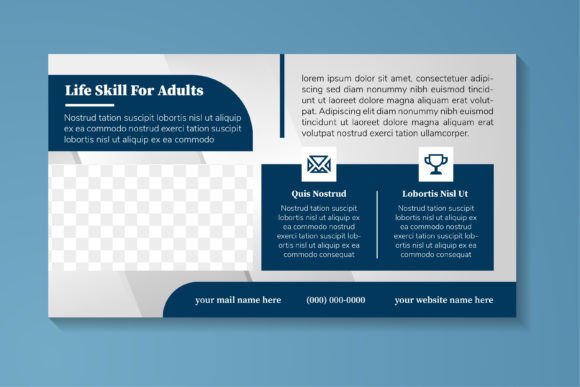
Over the past decade, the demand for high-quality, scalable visual assets has grown exponentially. Businesses and educational institutions alike have moved away from static, text-heavy communication toward rich, modular designs that adapt instantly to different formats. The Life Skills Horizontal Banner exemplifies this shift. It is intentionally constructed with a grey gradient background, layered graphic elements, and dedicated space for photo collages — all in vector format at 300 DPI resolution. This means you are not buying a one-off image; you are investing in a system.
Vector-based resources have become the backbone of efficient creative production. Unlike raster images that lose quality when resized, vector graphics remain crisp whether displayed on a smartphone screen, a trade show banner, or a billboard. The inclusion of editable text, shapes, and colors in the Life Skills Horizontal Banner file set — available in AI, EPS, JPG, and SVG — ensures that the asset speaks directly to the workflow preferences of modern professionals. No two projects need to look the same, yet the foundation remains reliable.
Why Horizontal Layouts Dominate Event and Training Promotion
Horizontal banners are not a new invention, but their strategic use has been refined by the digital and physical ecosystems we navigate daily. The horizontal format mirrors the natural aspect ratio of most screens, social media headers, website hero sections, and presentation slides. A Life Skills Horizontal Banner works seamlessly as a Facebook cover, a LinkedIn event banner, a flyer insert, or a poster for a community center. This inherent flexibility reduces the time spent reformatting content for different channels.
Event organizers and training facilitators especially benefit from this layout because it allows hierarchical placement of information: headline on the left or center, supporting visuals on the right, and descriptive text underneath. The space reserved for photo collage — a feature explicitly mentioned in the resource description — enables personalisation with images of real participants, workshop materials, or lifestyle shots that evoke the "life skills" theme. This combination of structure and adaptability is precisely what professionals need when they have limited time but high expectations for visual polish.
The Psychology Behind the Grey Gradient and Minimalist Aesthetic
One might question why a grey gradient background has become such a popular choice for professional banners. Colour psychology in design is not a trivial consideration. Grey, when used as a gradient, communicates neutrality, sophistication, and calm. It does not compete with foreground content — text, icons, photos — but rather creates a stable visual foundation. For a Life Skills Horizontal Banner, which often promotes adult education, personal development, corporate training, or wellness programs, this neutrality is an asset. It allows the message to take centre stage without the distraction of overly vibrant or thematically conflicting colours.
The gradient element adds a layer of depth that flat grey cannot achieve. It suggests movement, transition, and growth — all of which align with the concept of "life skills" itself. People attending seminars or browsing course catalogues are often in a mindset of self-improvement or professional development. A banner that visually evokes progress and openness reinforces that intention. Designers who choose this resource are not merely picking a colour scheme; they are making a psychological choice that supports the viewer's receptivity.
Infographics, Icons, and Information Architecture
Modern audiences process visual information faster than text. The inclusion of flat icons, infographic elements, and intuitive layout structures in the Life Skills Horizontal Banner meets that expectation head-on. Keywords associated with this resource — such as cognition, competence, consulting, development, education, innovation, and knowledge — reflect the breadth of contexts in which it can be applied.
Consider a corporate training session on emotional intelligence or conflict resolution. A banner that arranges concepts like "explore," "motivation," "experience," and "interaction" alongside relevant icons immediately communicates the session's value without requiring a single line of body copy. For marketers, this means faster engagement. For educators, it means clearer messaging. For freelancers, it means a professional-looking asset that can be delivered to a client in minutes, not hours. The information architecture of a well-designed Life Skills Horizontal Banner does the heavy lifting of visual persuasion.
Why Professionals Are Paying Attention to This Resource Category
A quick scan of online design marketplaces reveals a surge in demand for bundles that combine multiple format types — AI, EPS, JPG, SVG — within a single download. The reason is pragmatic. Creative professionals work across different software ecosystems. A designer using Adobe Illustrator prefers AI or EPS; a marketer compiling a quick social campaign might reach for SVG or JPG. By covering all four, the Life Skills Horizontal Banner resource eliminates compatibility friction. It respects the user's workflow, not the other way around.
Moreover, the high resolution of 300 DPI ensures print readiness. While many digital-first designers have grown accustomed to 72 DPI screen resolutions, print applications remain vital for events, conferences, and physical promotions. A resource that bridges the digital-print gap without requiring resampling or re-exporting is invaluable. The Life Skills Horizontal Banner is explicitly marketed as meeting both digital and print standards, which speaks directly to the needs of hybrid event promoters and brick-and-mortar institutions that still rely on flyers and posters.
Personal Branding and Niche Authority
For independent consultants, coaches, and small business owners, the Life Skills Horizontal Banner is more than a design asset — it is a shortcut to looking established. Building a cohesive visual brand from scratch is time-consuming and often expensive. Templates that allow customisation of text, colour, and imagery enable professionals to maintain a consistent look across all their materials without hiring a full-time designer. This democratisation of quality design is one of the most significant trends in the creative industry today.
When a life coach uses a Life Skills Horizontal Banner for a workshop series, the audience perceives a level of professionalism that builds trust. When a corporate HR department deploys the same template style for multiple training modules, employees recognise the branding and associate it with consistent quality. The editable nature of the resource means that updates — changing a date, swapping a photo, adjusting a headline — are trivial. Over time, this efficiency compounds, freeing up resources for strategic work rather than repetitive layout adjustments.
Connecting the Banner to Broader Industry Trends
The relevance of the Life Skills Horizontal Banner extends beyond individual projects. It is part of a larger movement toward modular, reusable design systems. In the same way that companies now build component-based design libraries for their websites and apps, event and training professionals are assembling libraries of templates for their offline and online promotions. A single well-designed banner file can be the starting point for a dozen different campaigns, each with subtle variations in copy and imagery.
This trend is supported by the growing adoption of "design thinking" in business environments. Organisations recognise that visual communication is not a decorative afterthought but a core driver of comprehension, retention, and action. The Life Skills Horizontal Banner directly supports this realisation by providing a framework that prioritises clarity, hierarchy, and emotional resonance. It is a tool for effective communication, not just decoration.
The Role of Photo Collage Space in Storytelling
One of the most distinctive features of this banner type is the dedicated space for a photo collage. In an era where authenticity and human connection are prized over stock imagery, being able to insert real photographs — of participants, facilitators, or event environments — transforms the banner from a generic advertisement into a genuine invitation. The collage space encourages storytelling. It says, "This is not abstract; real people are part of this experience."
Nonprofits, community organisations, and educational institutions particularly benefit from this feature. They often operate on tight budgets but have compelling visual stories to tell. A Life Skills Horizontal Banner that allows them to combine images of engaged learners with concise descriptive text becomes a powerful fundraising and recruitment tool. The grey gradient background acts as a neutral canvas that makes any set of photos look cohesive, even if the original images vary in lighting or style.
Practical Observations on Workflow and Customisation
From a practical standpoint, the best design resources are those that reduce friction without sacrificing quality. The Life Skills Horizontal Banner achieves this by offering organised layers within the vector files. Shapes, text, and graphic elements are separated, allowing users to hide, move, or recolour components with minimal effort. This is not a trivial feature; it reflects an understanding of how real designers work. They do not want to spend time ungrouping messy artwork. They want to open a file, make targeted changes, and export.
The inclusion of keywords such as "academy," "adult," "benefit," "business," "consulting," "corporate," "development," and "growth" within the resource metadata also improves discoverability. For creators searching for a solution that fits a specific niche, these terms act as signposts. Whether you are designing a banner for a university extension program, a leadership workshop, or a community health initiative, the semantic alignment between the resource and your project reduces the guesswork.
Adapting Across Media Without Redesign
A single Life Skills Horizontal Banner file can serve as the basis for a billboard, a social media post, a flyer, a poster, and a web page header. This kind of cross-media readiness is rare in bespoke design projects unless planned from the outset. The resource is designed with the understanding that modern promotions exist simultaneously in print and digital spaces. A training company might print 50 posters for office notice boards, use the same design as a LinkedIn event header, and later repurpose it for a slide within a presentation. The consistency reinforces brand recognition across touchpoints.
The 100% vector nature of the graphic elements means that scaling is never a concern. A detail that looks good at 10 cm will look equally sharp at 10 metres. For event sponsors or trade show exhibitors, this eliminates the anxiety of sending files to print without knowing the exact final dimensions. The Life Skills Horizontal Banner provides a rare combination of flexibility and reliability.
Final Reflections on Choice and Value
Ultimately, the decision to use a Life Skills Horizontal Banner is a decision to prioritise clarity, efficiency, and emotional impact. It is a choice that acknowledges the realities of modern professional life: tight deadlines, diverse platforms, and the need for authentic human connection. The resource is not merely a collection of graphic elements; it is a communication strategy made tangible.
As audiences become more visually literate, the expectations for what a banner should deliver continue to rise. A static, cluttered design no longer suffices. People want to see, at a glance, what an event or program offers, why it matters, and who it is for. The Life Skills Horizontal Banner meets this demand by combining editable structure with aesthetic restraint. It gives creators the power to tell their story without shouting, and to invite participation without overwhelming the viewer.
Whether you are promoting a weekend life skills retreat, launching a corporate learning initiative, or building a library of templates for your freelance studio, this asset deserves a place in your toolkit. Its thoughtful design, high resolution, multi-format availability, and vector precision make it a resource that transcends trends. It is built to work, and it is built to last. In a noisy world, that kind of reliability is not just convenient — it is essential.
Thank you for choosing my store. I wish you a good day. Please contact me if you have any questions.